
“You are writing for a screen someone is holding”: the creator of Night Shift on portrait-first drama
Yemi Adesanya built a hospital series around one corridor, one shift and a lead nurse the camera never leaves. She explains why the phone changes the writing before it changes the shot.
Listen to this story
Audio edition
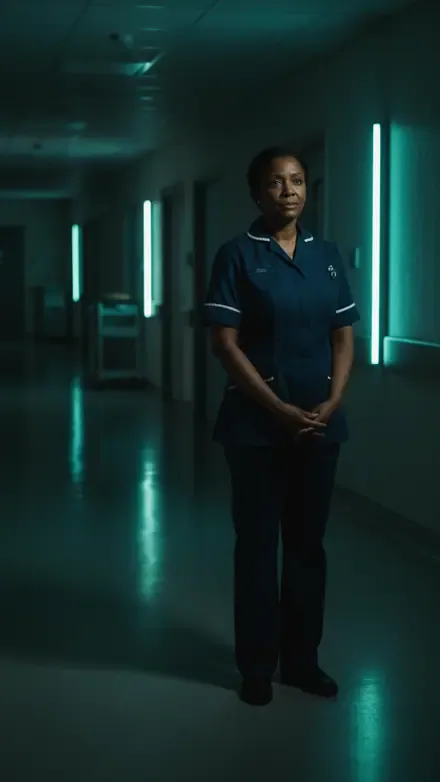
Night Shift is the rare vertical series people describe by its geography: one A&E corridor, filmed across a single night shift per episode, built around Ada Okonkwo — a charge nurse whose face carries more of the series than its plot does. Its creator, Yemi Adesanya, wrote for broadcast television for a decade before moving to portrait. We spoke about what actually changes when the screen turns.
You’ve said the phone changed your writing before it changed your directing. What did you mean?
The screen is in someone’s hand. That sounds banal, but it is the entire grammar. Television is watched across a room — you write scenes that survive distance. A phone is held at thirty centimetres. Intimacy isn’t a style choice, it’s the default condition. So you stop writing establishing beats. You write proximity. My scripts lost almost all their scene headings and gained lines about where breath goes.
The corridor is doing a lot of work.
A corridor is a portrait frame that exists in the real world. We didn’t have to fight the aspect ratio; we found the place where the world is already vertical. Doors, trolleys, strip lights, two people close together or one person alone — the geometry gives you your coverage. When people ask how we shoot so fast, that’s the answer. The location is the shot list.
What does Ada see that we don’t?
Everything. The audience is her second patient. The rule in the writers’ room is that Ada never explains — she notices, and the camera stays close enough that noticing reads. On a sixty-inch screen you’d need dialogue. At thirty centimetres, an eyeline is a sentence.
The show shoots a full episode per night shift, in sequence. That’s unusual discipline.
It’s the cheapest special effect we have. Everything ages truthfully across the night — the light, the ward, the faces. By four in the morning nobody on that corridor is acting tired. And the sequence protects the writing: because we can’t reshoot yesterday, the scripts have to be locked in a way that forces decisions early. Vertical budgets don’t buy indecision. The schedule is the aesthetic.
Where does the format still frustrate you?
Silence. The economics push everyone toward incident — something must turn every forty seconds or the deck says people leave. I don’t think that’s a law of physics, I think it’s a habit of commissioning. The scenes people send each other from our series are the quiet ones. Ada standing in the supply room for eleven seconds. The format can hold stillness; the spreadsheets just haven’t caught up with the audience.
What would you tell a broadcast writer moving to vertical this year?
Cut your first page. Whatever you wrote to arrive at the story, the format has no room for it. And stop treating the length as a constraint — a ninety-second episode is not a compressed forty-minute episode, it’s a different unit of story. The writers who thrive are the ones who hear it as verse, not summary.